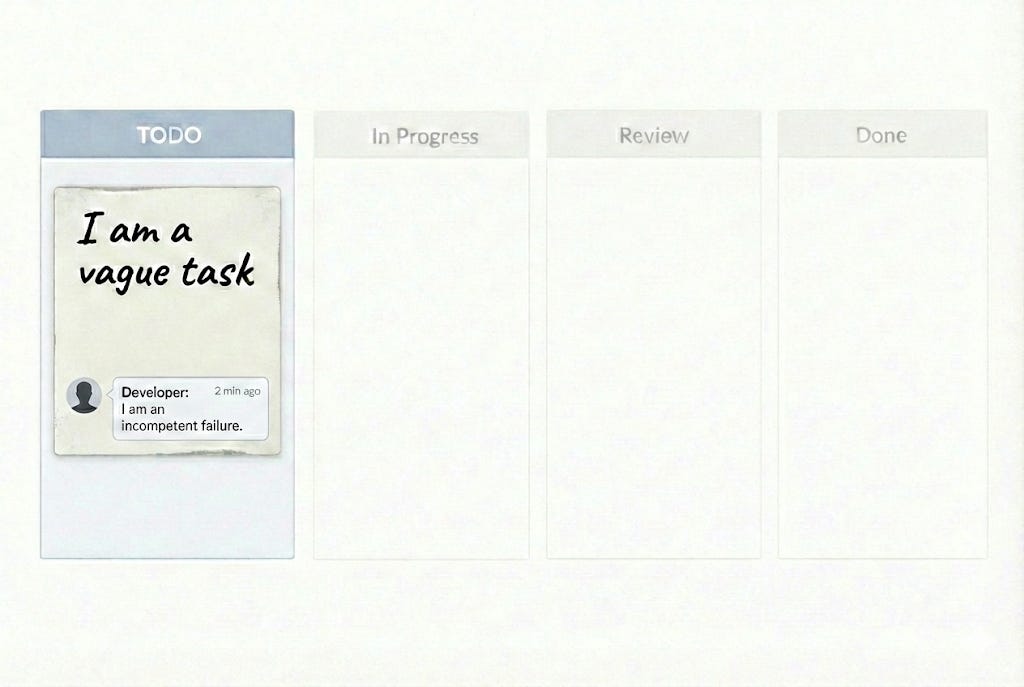
When ADHD turns “I'm stuck” into “I suck”
A closer look at the spiral from confusion to shame.
The Task That Never Asked to Be a Judgment
There’s a moment that often starts quietly:
Why can’t I just start this task?
Nothing is on fire yet.
No one is waiting.
No feedback has landed.
Just a task sitting there in your ticketing system.
If the task could speak, it would say:
Hi! I am three sentences without any acceptance criteria.
That’s all.
No insult.
No commentary.
But the mind doesn’t stay with that for long.
Your Response
Comparison slips in almost immediately:
Everyone else seems able to do this type of task.
Now the task isn’t just a task anymore.
It’s evidence.
The task responds, plainly:
Some people are more comfortable making starting assumptions.
Still neutral.
Still descriptive.
But something has already shifted.
Your question now changes:
So what does that say about my worth?
This is the pivot point.
The task hasn’t become clearer.
But the meaning attached to being stuck has.
Where self-judgment sneaks in
The lack of movement starts to feel like a verdict.
The task says back to you:
No, this says nothing about your worth.
But that answer doesn’t land.
Because the mind is no longer focused on this individual task.
It’s focused on identity.
So the mind escalates:
No, it means I am an incompetent failure.
And the task replies, almost confused:
I never said that.
This is the quiet rupture.
The task didn’t accuse you.
The task didn’t generalize.
The task didn’t make it personal.
But the judgment arrived to explain the discomfort of not knowing how to start.
What’s actually happening here
In real coaching conversations, this moment usually isn’t about motivation.
It’s about ambiguity.
Navigating ambiguity is painful for the ADHD mind.
But in the moment, the mind is not aware of that.
All the mind knows is that it is experiencing the discomfort of not knowing.
And when that discomfort becomes unbearable, the mind looks for relief.
And the self-judgment offers a strange kind of relief.
“I am bad” is painful — but it’s clean.
It gives the mind something solid to hold onto when uncertainty feels intolerable.
What changes when this is noticed
Nothing magically gets easier.
The task is still underspecified.
The acceptance criteria are still missing.
But something important separates.
Instead of the mind jumping to:
What’s wrong with me?
There’s room for:
What is unclear about this task?
Who can I talk this out with?
What starting assumptions can I make?
The pressure drops just enough for the self-attack to stop escalating.


One thing I used to avoid is working through a long list of phone numbers to call, to find one of them to do some service for me. But then it clicked: I filter for proximity, recommendations or how large they are and create a shortlist of whom to call first. Today again. The first one was free so no second call needed.